
Prepared By: Buckeye Environmental Network
Edited As Of: June 23rd, 2026
Redbird #4 Class II Injection Well
American Petroleum Institute #34167297670000
Dunham Township, Washington County, OH
In 2018, Redbird Development LLC obtained a permit from the State of Ohio and began injecting waste into the Redbird #4 Class II oil and gas disposal well, a type of well commonly referred to as an “injection well.” “Redbird”, as the well is referred to by locals, is located in Dunham Township, approximately 3.5 miles northwest of the city of Belpre in Washington County, the number one county in the state of Ohio for injected wastewater from oil and gas production (aka “brine waste”).
About a year into Redbird’s operations, nearby owners of conventional oil and gas wells (old-fashioned, vertical wells) noticed a significant change in the behavior of their wells. Wells that were once normal and productive were suddenly becoming flooded with unnatural and unending amounts of fluid. The well owners reported that they could not get rid of the fluid on these dozens of wells and that the wells were no longer producing gas and oil. While some brine waste is expected in the production of conventional wells, along with crude oil and gas, this new brine was white in color, heavier, and had a stronger odor. The well owners suspected that this was injected brine waste that was leaking, travelling, or “migrating” from nearby disposal/injection wells. A total of 28 production wells that had been producing for several decades went down within a matter of weeks.
In 2019, the group of impacted well owners immediately communicated these issues to the Ohio Department of Natural Resources Division of Oil and Gas Resource Management (DOGRM), the state agency that regulates Class II injection wells. Despite these well owners’ expertise, decades of experience, and ability to detect a problem, DOGRM downplayed their concerns, denied that there was a problem, and told the well owners that injection wells could not migrate brine waste outside of their intended disposal zone. After six months of reporting the worsening issues to DOGRM, the group finally reached out to their state representative Jay Edwards to ask for help and to demand the attention of the Division. It was only after the state representative helped to broker a meeting between DOGRM officials and the well owners that DOGRM acquiesced and investigated these reported brine waste migration concerns. The agency’s investigation would prove just the opposite of what it had claimed.
DOGRM hired Colorado-based consulting and engineering firm, Resource Services International, Inc. to investigate the reported issues. Resource Services analyzed data and performed geological studies that led to the State Agency’s Washington County Produced Water Investigation report. The consultant analyzed brine waste from 15 different oil and gas wells in the vicinity of the active injection wells, confirming that the fluid had migrated out of its intended injection zone from Redbird and some of the 4.2 million gallons of brine waste injected by that point had leaked into and infiltrated the nearby oil and gas wells. Some of these producing wells were over five miles from the injection well. The investigation concludes:
Wastewater injected into the Ohio Shale Formation from the Redbird #4 well is the source of brine that has appeared in several production wells drilled into the adjacent Berea formation. Naturally occurring fissures exist between the Ohio Shale formation and the Berea Sandstone formation, allowing wastewater to migrate between the formations and into production wells.
Redbird Development LLC made modifications to their Redbird well and “voluntarily” sealed off the Ohio Shale geologic formation in May, 2020.5 In summary, DOGRM itself concluded that injected brine can migrate among the geologic formations. The Redbird #4 wells are still active today, along with two additional injection wells at the same site. The company drilled into a deeper geologic formation and resumed operations in 2020.
Within the investigation report, DOGRM attempted to reassure the owners of the production wells that “the brine volumes in the impacted production wells are expected to decrease and natural gas production will return to expected rates”5. Despite this presumption, DOGRM’s own inspection reports demonstrate that the pressure on production wells has increased over time.
Wilson Energy LLC was one of the companies that initially complained about increasing brine waste in its oil and gas wells. One of the wells infiltrated with foreign brine waste was the Wilson Energy LLC Glen Nichols #5 well. This well is located 3.5 miles northeast of Redbird #4. The April 22nd, 2020 inspection report for Glen Nichols #5, states “casing pressure @ [at] 85 psi with fluid present at surface on tubing.” Fast forward to present day, DOGRM’s most recent inspection report from May 2026 clocks the psi at an astonishing 218 psi. DOGRM’s own records demonstrate that the pressure has nearly tripled from 2020 to 2026.
Buckeye Environmental Network was invited to visit the Glen Nichols #5 well on May 20th, 2026. Accompanied by Wilson Energy’s owner, Bob Wilson, along with a local well operator, Dale Hoon. Mr. Wilson stated that about six additional oil and gas wells had been flooded with brine waste recently, which were not flooded before, and that other wells in addition to Glen Nichols #5 are also increasing in pressure. Mr. Wilson also stated that the division inspector was previously checking the pressures on many of his wells once per month for the past 6-8 months. He reported that the inspector is now visiting the oil and gas well sites in the area weekly, increasing in frequency from prior monthly visits.
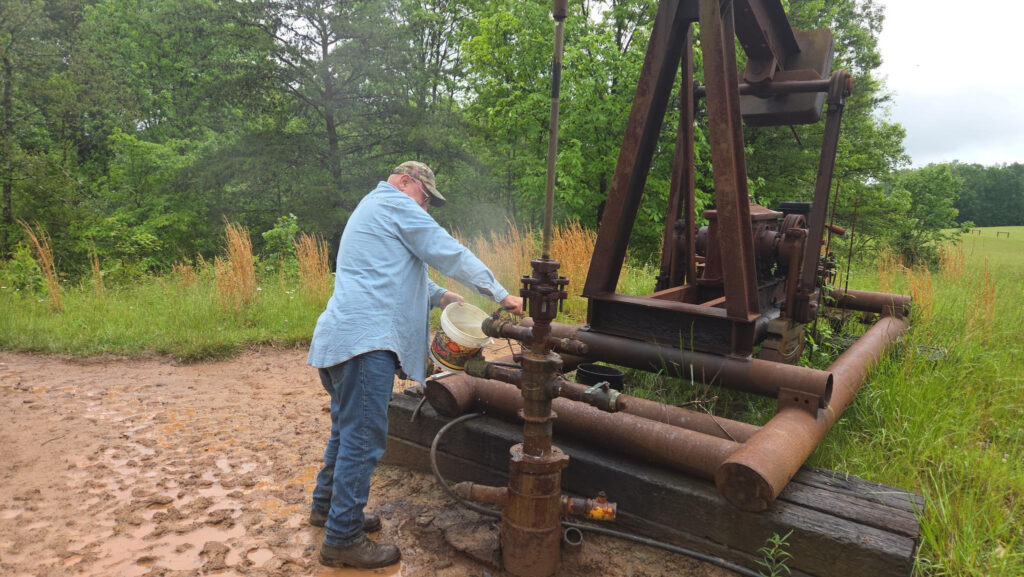
*Pictured is owner of Wilson Energy, Bob Wilson, demonstrating the Glen Nichols 5 well head under pressure and violently shooting out oil and gas waste brine. Photo credit: Buckeye Environmental Network. May 20th, 2026.
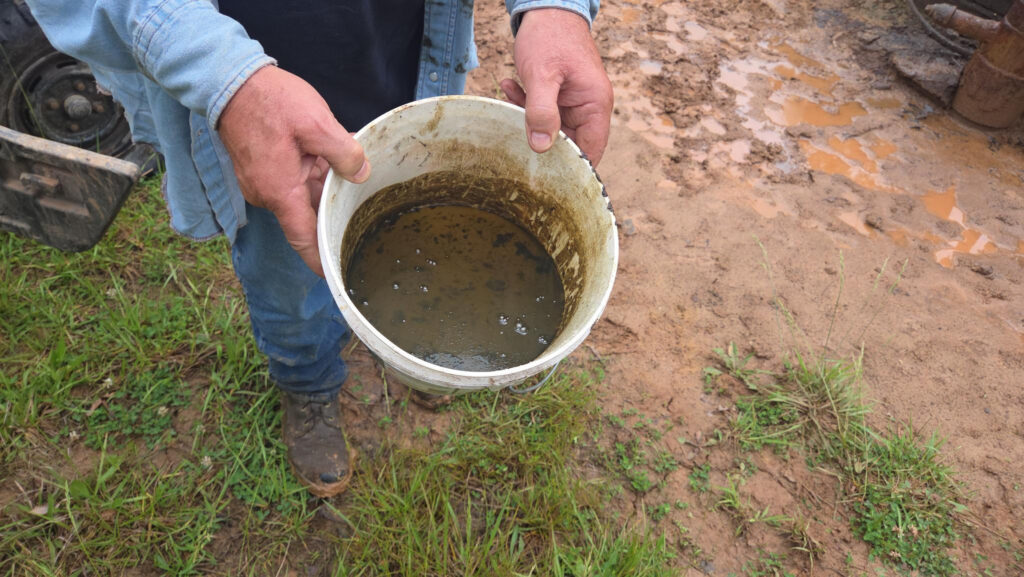
*Owner of Wilson Energy, Bob Wilson, holding a bucket of brine waste from Glen Nichols 5 well. Photo credit: Buckeye Environmental Network. May 20th, 2026.
Mr. Wilson told us about two other wells near Redbird that have increased in pressure since 2020 and especially within the past 6-8 months. He stated that his wells closest to Redbird maintain the most elevated pressure readings. The Curry #3 is the closest well to Redbird (1.61 miles northeast). The pressure was 20 psi on the tubing in September 2023. There is no inspection report recorded between September 2023 and October 2025. In October 2025, the tubing pressure was 195 psi. The most recent inspection recorded on May 13th 2026 does not include a pressure reading. However, on April 28th the tubing pressure was recorded at 250 psi. The Curry #3 well has increased in pressure by 1250% since September 2023.
The Irving Reynolds #2 well is 3.71 mi northeast of Redbird. It had a reading of 0 psi in September 2023. In October 2025 the tubing pressure was 90 psi. There have been seven inspections since the 2025 inspection and the most recent inspection on May 8th, 2026 revealed a pressure of 162 psi. The pressure has elevated from 0 psi to 162 psi since 2023 – 6 years after the Produced Water Investigation Report findings were published.
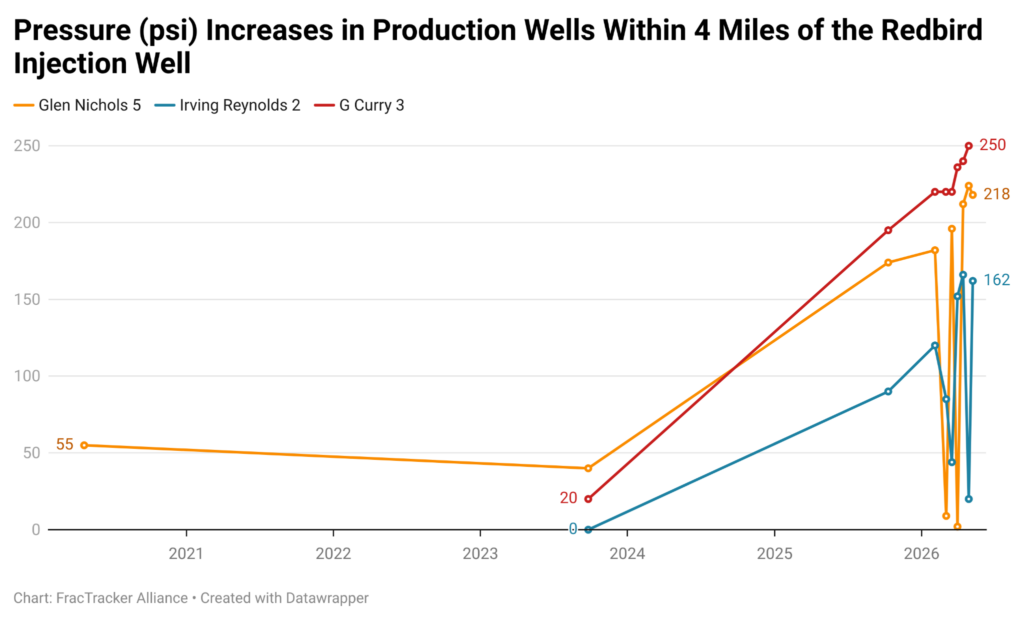
Furthermore, despite the modifications that Redbird Development “voluntarily” completed on its injection well, the same issues persist to this day. Multiple wells have increased in pressure exponentially, yet DOGRM still has not investigated the brine migration situation in Washington County in any long-term way to determine the depth of the problem.
ODNR Division of Oil and Gas RBDMS Inspection Reports are public records, and are typically updated weekly by the Division and can be found within its public database. The inspection reports for these impacted production wells are spotty and do not paint a full picture of the brine waste migration issues in Washington County. Many of the inspections have no systematic frequency. Some inspections don’t list a pressure check. Most wells are not checked according to any consistent time schedule so it is difficult to understand the well status over time. The comment section is not consistent throughout the inspections and well sites. The impacted wells since the 2020 Washington County Produced Water Investigation Report have not all been monitored since that timeframe. The three impacted wells highlighted above were not visited from 2021-2022, with one inspection in 2023, no inspections in 2024, and one in 2025. The frequency of visits has increased in 2026. All of this information is according to the RBDMS database that is available to download on ODNR’s website. This spotty information is not adequately informing the public of the Agency’s actions in protecting the public and the environment.
Other injection wells in parts of Washington County have been suspected of migrating brine waste and have not been properly investigated to date. The 2021 blowout of an abandoned well in Veto Lake, less than a mile from Redbird cost the State several hundred thousand dollars, and an investigation of the cause was never conducted. This is negligence on the part of DOGRM. Despite well blowouts and migration incidents occurring in multiple southeastern counties of Ohio, including Washington, Nobel and Athens, to-date there has been no long-term, thorough, systemic analysis of the brine waste migration saga within southeastern Ohio. DOGRM has the ability to do this long-term monitoring, yet it has chosen not to.
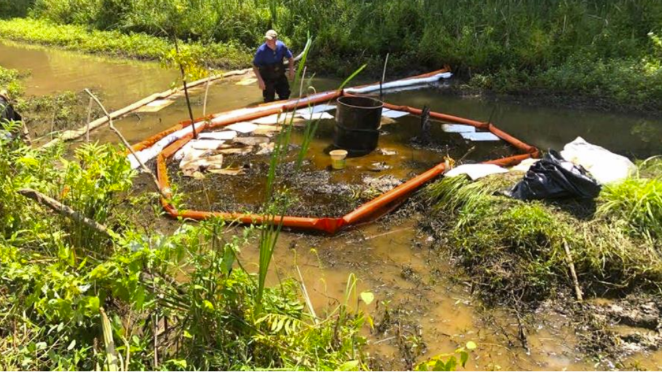
*The RedBird #4 well is an injection well that impacted many production wells in the Veto Lake area including Bob Lane and Bob Wilson’s wells. Pictured is a blown production well in Veto Lake. Photo credit: Roxanne Groff, 2021
Bethel Oil and Gas LLC and Wilson Energy LLC, which both operate hundreds of conventional oil and gas production wells on thousands of acres in Washington and Athens counties, sued Redbird and 15 other injection well operators, arguing their disposal practices damaged or could damage their production. That lawsuit is pending in the Ohio Supreme Court.
Since 2018, Redbird #4 has injected 270,908,316 gallons of brine waste. There are 5 injection wells within 4 miles of Glen Nichols #5, all potentially compounding the pressure within the geology in the area. The total injected volume into these five injection wells since 2010 is over 1.3 billion gallons: about 42% of the total injected waste in Washington County since 2010. Washington County has been forced to accept over 3.1 billion gallons of brine waste since the horizontal shale drilling development began around 2010.
Oversight and management of Class II wells has been questioned by Ohio elected officials and citizens since 2011 when the permitting of Class II wells increased due to the horizontal drilling shale development in Ohio. DOGRM did not and has not thoroughly investigated the geology of southeast Ohio to determine the region’s ability to accept the pressures and volumes of the waste permitted. This lack of oversight has led to six wells migrating brine waste into production wells, seismic activity, and lawsuits. Rather than having sufficient experts within the agency to manage the Division and respond quickly to threats, DOGRM hires consultants to evaluate problems. The agency should be conducting an ongoing investigation into the possible migration of oil and gas waste and continue conducting testing of private water wells within at least 5 miles of each problem injection well.
DOGRM passed new rules in 2022 governing Class II wells that should better protect our communities. However, the new rules were not applied to 3 newly permitted injection wells in Washington and Noble counties, including 2 wells that are within 2 miles of Marietta’s Source Water Protection Area. Division Chief Vendel says the problem wells suspected of migration are being “monitored”. Monitoring is not investigating. Elected officials are expected to find answers to the concerns of their constituents. There will be no assurance that Washington County’s drinking water supplies are safe from toxic, radioactive oil and gas waste until injection volumes and pressures are reduced or injection wells in this county are eliminated.
Buckeye Environmental Network is calling on ODNR to:
- Immediate suspend injection operations in the area and monitor for changes after injection has ceased
- Launch a long-term, systemic investigation into brine waste migration across southeastern Ohio, not just at Redbird
- Apply consistent pressure monitoring and reporting standards to every well with a history of migration concerns
- Test private water wells within at least five miles of any injection well suspected of migration
Sources:
- RedBird #4 Permit_2018.Pdf
- https://gis.ohiodnr.gov/MapViewer/WellSummaryCard.asp?api=34167297670000
- Washington County Produced Water Investigation report
- Page 15 of Washington County Produced Water Investigation report
- Page 1 of Washington County Produced Water Investigation report
- ODNR RBDMS Inspection Report Glen Nichols #5, April 22, 2020, Comment
- ODNR RBDMS Inspection Report Glen Nichols #5, May 8, 2026, Comment
- Curry 3_RBDMS_6.3.26.pdf September 26, 2023, Comment
- Irving Reynolds 2_RBDMS_6.2.2026.pdf May 8th, 2026, Comment
- https://www.dispatch.com/story/news/environment/2021/08/23/ohio-investigating-after-crude-oil-release-noticed-near-veto-lake/8203369002/?gnt-cfr=1&gca-cat=p&gca-uir=true&gca-epti=z1168xxe1168xxv000052&gca-ft=122&gca-ds=sophi
- https://signalohio.org/ohio-landowners-say-fracking-wastewater-is-leaking-underground-threatening-drinking-water/
- https://benohio.org/for-immediate-release-lawsuit-filed-over-ohio-dept-of-natural-resources-use-of-outdated-rules-for-dangerous-injection-wells-near-marietta/