
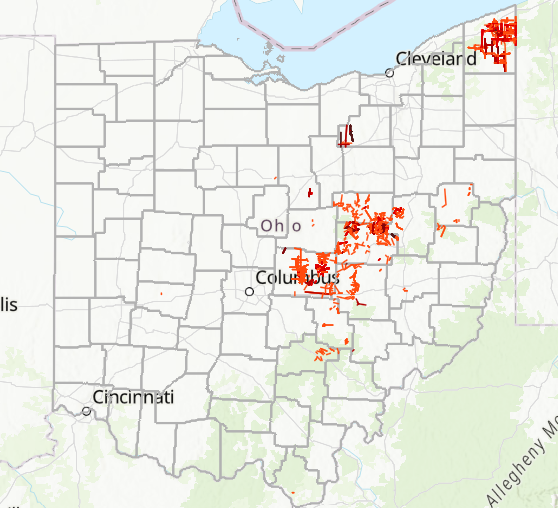
The disposal of toxic and radioactive oil and gas waste brine has improved dramatically over the centuries of oil and gas extraction. Before oil and gas waste disposal saw any type of regulations, it was not uncommon for it to be dumped into the nearest creek to dispose of it. Yet, archaic practices remain in the disposal of oil and gas waste brine including the disposal on roadways. Ohio is one of thirteen states who legally allows the radioactive byproduct to be applied to roadways in the name of deicing and dust suppression despite peer reviewed publications demonstrating the lack of effectiveness.
Although Ohio law does not necessitate the testing for radioactive or toxic constituents before disposal like neighboring states (Pennsylvania, West Virginia, and Michigan), Ohio does maintain somewhat comprehensive annual spreading reports. These ‘Annual Surface Application Report Forms’ detail what roads saw the application of brine and in the volume (measured in barrels or ‘bbls’) spread onto the road.
Buckeye Environmental Network makes public records requests in order to keep track of the most up-to-date information. We have traditionally used these annual reports to stay informed of which communities are most effected on a year over year basis. Most recently, BEN has partnered with Ohio State University to turn these public records into an interactive map in which community members can get a sense of how heavily oil and gas waste brine has been spread in their communities the last ten years.
Projects like this one turn an invisible environmental justice issue into a learning experience for the community. Even when residents are cognizant of the ‘brine trucks’ rolling down their roads to keep dust down on a hot summer day, they assume that what is being applied is safe. Maps like this help us inform community members that they are subject to potential health risks from known carcinogens like radium 226, radium 228, benzene, and more.
The use of oil and gas waste on roadways is a decades old practice instituted to make it cheap for producers to dispose of their waste. The practice was legalized in 1985 before Ohio Department of Natural Resources had known that oil and gas waste brine was highly radioactive. This issue is much like asbestos. Now that Ohio’s State Agencies have raised the alarm, common sense legislation needs to follow so that Ohioans can be free from further cumulative exposure. With our family’s health on the line, local governments cannot simply make the excuse that we need to opt for the cheapest possible option. Not only are there other nonradioactive options available for local governments to purchase, there are creative and innovative ways that local governments have made a transition away from toxic and radioactive oil and gas waste brine.
If you’d like to learn more about oil and gas waste spreading in your community, reach out to our oil and gas waste organizer, Anton Krieger – anton.krieger@benohio.org . If you learned something from this blog post and want to support our work, please consider donating to us: https://benohio.org/give/
To sign our petition to demand the end of oil and gas waste brine being spread on our roads, click here.
This map was created by Greg Chang, PhD, under the direction of Arbor Quist, PhD, with assistance from Yuehua Duan and Celia Donovan.